Why Golden Analytics Doesn’t Charge for Tokens
The entire purpose of analytics is curiosity. It’s helping people explore their data, ask better questions, and discover things they didn’t know before. That's why Golden Analytics doesn't charge for tokens.
Pricing is one of those topics that often feels more like art than science.
When we started thinking about pricing for Golden, there were plenty of options. We could charge by consumption. We could charge by tokens. We could charge based on outcomes. We could invent some entirely new metric.
If you spend enough time on Twitter or listening to industry pundits, you’ll hear that user-based pricing is dead. Everything should be consumption-based. Everything should be outcome-based.
In many cases, that’s exactly right.
But when we thought about what we were trying to accomplish with Golden, we came to a different conclusion.
Pricing should reinforce behavior
The question we kept asking ourselves was simple:
What behavior do we want to encourage?
The answer was obvious.
We want people to ask more questions.
The entire purpose of analytics is curiosity. The value isn’t in creating a dashboard. The value is in helping people explore their data, ask better questions, and discover things they didn’t know before.
So why would we charge people every time they do the thing we’re trying to encourage?
Imagine if Slack charged per message sent.
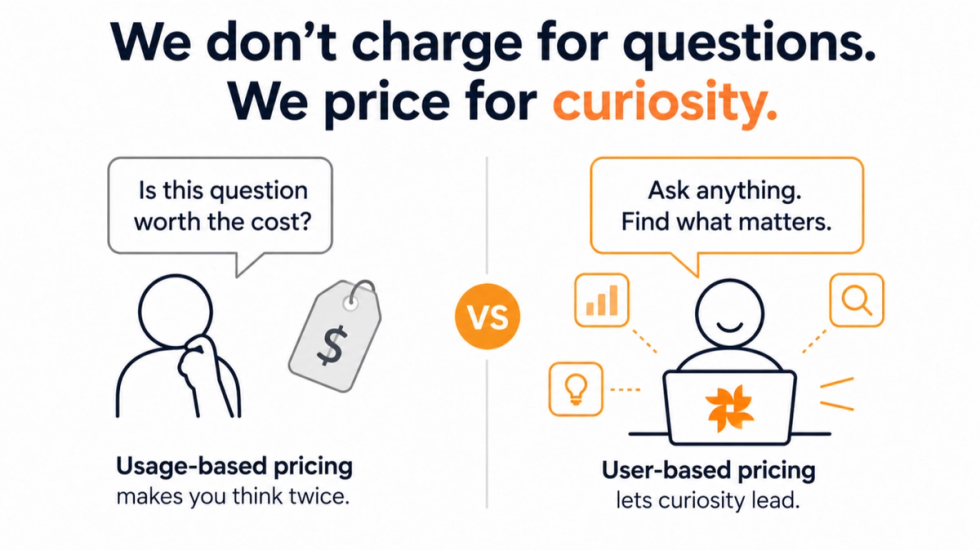
Before sending a message, you’d stop and think: “Is this question worth the cost?”
That sounds ridiculous.
Yet that’s exactly what happens when analytics platforms charge based on queries, consumption, or token usage. Every question suddenly has a price tag attached to it.
Users become more cautious. They explore less. They ask fewer follow-up questions.
The pricing model starts working against the purpose of the product.
We didn’t want that.
So we went against the grain
Golden is priced per user.
And tokens are included.
That’s right. We don’t charge separately for token consumption.
When I tell customers this, the reaction is usually the same.
“Wait. Really?”
Then comes the follow-up question:
“How can you afford to do that?”
The answer comes down to three beliefs.
First, we’re taking a long-term view
Our bet is that AI model costs will continue to fall.
The capabilities of the models are improving at an incredible pace, but the models themselves are becoming increasingly commoditized.
We’ve seen this movie before.
In the early days of cloud computing, storage was expensive. Over time, competition and technology improvements drove prices down dramatically. What was once a major cost became almost an afterthought.
We believe something similar will happen with AI models.
The economics that exist today won’t look the same a few years from now.
So while token costs matter today, we’re making decisions based on where the market is heading, not where it currently sits.
Second, we don’t rely on a single model
Golden isn’t built around one LLM.
Behind the scenes, we use a constellation of models.
Different models are better at different tasks. Some optimize for cost. Some optimize for speed. Some optimize for deep reasoning.
Most people interacting directly with AI tools end up using the same model for everything. It’s like using a sledgehammer for every job.
But not every analytics task requires the most powerful model available.
Some tasks can be handled by a lightweight model. Others benefit from a more sophisticated one.
Golden automatically makes those decisions behind the scenes.
Customers don’t need to think about model selection, latency tradeoffs, or cost optimization. We handle that for them.
The right model gets used for the right job at the right time.
Third, efficiency matters when you’re paying the bill
Because we absorb token costs, we’re highly motivated to use them efficiently.
That’s a very different incentive structure than what exists in the broader AI ecosystem.
Frontier model providers naturally want customers consuming more tokens. More usage means more revenue.
Our incentive is different.
Our goal is to help customers answer questions about their data as efficiently as possible.
That means investing heavily in optimization.
We’ve built purpose-built workflows for analytics. We’ve engineered systems that minimize unnecessary prompt traffic. We’ve designed the product to get more work done with fewer tokens.
Some really smart engineers on our team spend a lot of time solving exactly these problems.
The result is that we can deliver more value per token than a generic chat interface ever could.
When you’re paying the bill, efficiency becomes a feature.
Alignment matters
At the end of the day, pricing is really about incentives.
If customers pay for every token, they’re incentivized to ask fewer questions.
If vendors make more money when customers consume more tokens, they’re incentivized to maximize token consumption - even when they make mistakes.
We wanted a different alignment.
We want customers to ask questions and get insights quickly.
We want them following every thread of curiosity without worrying about whether they’re about to hit a budget limit.
By including tokens in the price, we take on the responsibility of managing efficiency. Customers can focus on getting answers.
That’s the trade we want to make.
Are we crazy?
Maybe a little.
But we think simplicity wins.
We think analytics should be easy to buy, easy to understand, and easy to use.
No token budgets.
No consumption calculators.
No surprise invoices.
Just ask questions, get answers, and find insights.
We’re making a long-term bet that this is the right way to build an AI-native analytics company.
And we’re making that bet alongside our customers.