Dashboards Aren’t Dead. They’re Dead Ends.
For most of the history of BI, we’ve divided the world into creators and consumers. Dashboards aren’t the problem — the idea of a “consumer” is. Here’s how we’re reimagining the consumption experience in Golden.
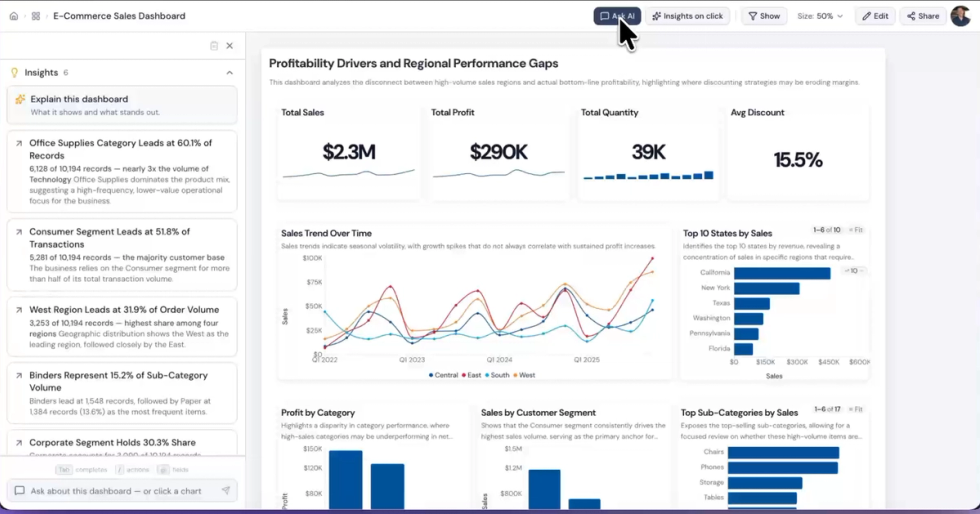
People talk about dashboards being dead. I think that it’s more that they are dead ends.
For most of the history of BI, we’ve divided the world into two groups: creators and consumers.
Creators build. Consumers consume.
The creator builds a report or dashboard, anticipates the questions people might ask, and publishes it. The consumer gets to look at it, filter it, maybe click around a little.
And when the dashboard doesn’t answer the next question?
They ask someone to build another one.
It’s one of the reasons companies end up with thousands of reports and dashboards. Every new question creates another artifact.
I don’t think dashboards are the problem. The idea of a “consumer” is.
What if there were no consumers?
The creator/consumer model made sense because doing analysis required specialized skills and specialized tools. But AI changes that boundary.
It doesn't mean everyone suddenly becomes a data analyst. And it doesn't mean we give everyone a blank canvas and expect them to figure it out.
It means we can give everyone more agency.
If you don't understand something, ask.
If something looks interesting, investigate it.
If you want to know why something happened, dig into it.
If the dashboard doesn't answer your question, ask another one.
You don't have to stop because the person who built the dashboard didn't anticipate where your curiosity might take you.
That's what we've been rethinking in Golden.
A dashboard should be the beginning
Dashboards are actually really useful. They’re a great way to organize information, provide context, and give people a starting point.
But they shouldn’t be a dead end.
What happens when I see something interesting? What happens when I don’t understand what I’m looking at? What happens when the dashboard raises a question its creator never anticipated?
That’s where we’re reimagining the consumption experience in Golden.
You can still build a dashboard. You can still share it. You can still filter, highlight, drill and interact with the data.
But that’s just the starting point.
See it in action
Explain this to me
We’ve all opened a dashboard and spent the first few minutes trying to figure out what we’re looking at.
What are these metrics? What’s important? What is this dashboard actually trying to tell me?
So we added a simple capability: Explain this dashboard.
Golden looks at the dashboard, the data and the context and explains what you’re seeing.
Instead of staring at charts trying to orient yourself, you can just ask.
Tell me what’s interesting
Understanding a dashboard is one thing. Finding the signal in it is another.
Golden can automatically analyze what’s on the dashboard and surface the things worth paying attention to: changes, outliers, trends and other interesting patterns in the data.
You don’t just get the charts. You get help understanding the so what behind them.
Let me point at something
Sometimes exploration starts with something much simpler.
You see California sticking out on a chart.
Click it.
Golden can analyze that specific data point and explain what’s interesting about it. Instead of figuring out which filters to apply or which report to open next, you point at the thing you’re curious about and keep exploring.
It’s a little like having an analyst sitting next to you.
Let me ask the next question
And then there’s the question the dashboard creator never anticipated.
- Why did sales go up?
- How does this compare with last year?
- Which customers drove the change?
- What else should I be looking at?
Chat is built directly into the dashboard, so you can ask those questions without leaving the experience or asking someone to build something new.
The dashboard gives you a starting point. Your curiosity determines where you go next.
From consumption to exploration
That’s the bigger shift we’re interested in.
For decades, BI has been designed around creators and consumers. One group had the tools to explore and create. The other got the finished product.
AI gives us an opportunity to break that model.
The person looking at a dashboard doesn’t have to be a passive consumer anymore. They can understand. They can ask. They can investigate. They can follow their curiosity.
Maybe the future of BI isn’t about building better things to consume. It’s about giving everyone the freedom to explore.