Semantics Are Essential. A Semantic Layer Is Optional.
AI needs semantics. That doesn't mean you have to model your entire business before AI can be useful. Golden uses the semantics you already have, wherever they live.
There's a lot of hype around semantic layers right now.
The argument goes something like this: AI needs context to understand your data. Therefore, you need a semantic layer. Build the semantic layer, and suddenly AI will understand your business and give you the right answers.
We agree with the first part. Semantics make AI better. But we're much less convinced by the second.
We don't believe there will be one semantic layer that rules them all. And we certainly don't believe companies need to model their entire business before AI can be useful.
We've seen this movie before.
Remember the Universe?
Thirty years ago, BusinessObjects introduced the Universe, a way to hide the complexity of databases behind familiar business concepts. Instead of dealing with tables, joins, and cryptic field names, people could work with things like Customers, Revenue, and Profit.
It was a brilliant idea that helped make data accessible to a much broader audience.
But there was a downside. Over time, the Universe could become a constraint. If something wasn't modeled, it was difficult to explore. Changes required specialists. The model increasingly defined not just what people should ask, but what they could ask.
Self-service BI emerged in part because people wanted more freedom to explore, without waiting for someone to model every possible question in advance.
We shouldn't recreate the Universe for the AI era.
AI needs semantics. And a lot more.
Semantics and semantic layers are two different things.
Organizations already have business knowledge everywhere. Some lives in semantic layers in Snowflake, Databricks, and dbt. Some lives in data catalogs, BI tools, and applications. And plenty lives in documentation, wikis, metadata, and the institutional knowledge of employees.
All of that context matters.
Take something as simple as revenue. A semantic layer might define how revenue is calculated. But what about the fiscal calendar? Which customers are active? How are returns handled? Which data sources should people trust?
That knowledge doesn't necessarily live in the same place.
We don't believe all of this will magically consolidate into one universal semantic layer. Different systems will continue to own different pieces of context.
And that's okay.
What matters isn't where that knowledge lives. It's whether AI can understand and use it.
How Golden works with your semantics
This thinking has shaped how we've built Golden Analytics.
Our philosophy is simple: Use the semantics you already have, wherever they live. And if you don't have any, that's okay too.
Golden meets you where you are.

If you're using Snowflake Semantic Views or Databricks Metric Views, Golden automatically reads those definitions and queries them directly. Your metrics stay governed and are calculated where you defined them. No duplication or rebuilding.
If you're using another semantic layer, Golden supports the Open Semantic Interchange (OSI) standard. If your tool can export to OSI, you can import those definitions into Golden.
If your business context lives in documents, wikis, or websites, Golden can use that too. Business knowledge doesn't have to live in a formal semantic layer to be valuable.
And if you don't have a semantic layer at all, Golden can help infer semantics from your data to get you started. You can review and refine those definitions as you go.
Importantly, Golden doesn't rely on AI to invent SQL queries. We use deterministic query builders grounded in your data and semantic definitions, combining the flexibility of AI with the trust of governed data.
The goal is to make your existing knowledge useful, without forcing you to adopt yet another layer.
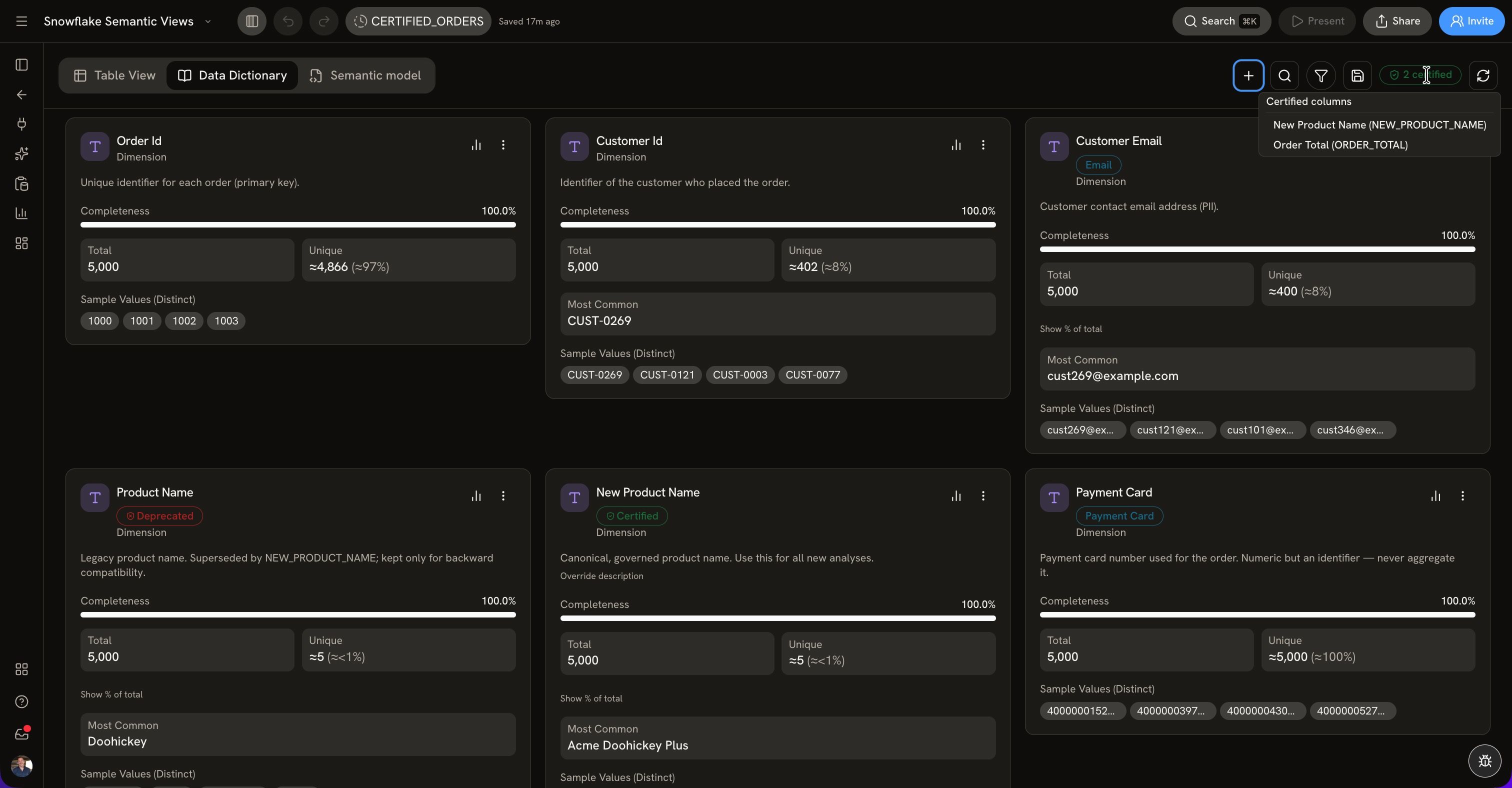
It's not about where semantics live. It's about what you do with them.
There's a lot of debate about where semantics should live. In the warehouse? A dedicated semantic layer? The BI tool? The AI platform?
We think that's the wrong question.
We don't want to own your semantics. We want to understand them, respect your governance, and use that knowledge to create a better analytics experience.
Because semantics shouldn't just help AI answer questions. They should help people explore.
Knowing how revenue is calculated matters. But so does knowing which data to trust, how concepts relate, and how the business actually works.
The opportunity isn't to build the perfect semantic layer. It's to make all that knowledge useful so people can ask better questions, follow their curiosity, and discover new insights.
Govern what you know. Explore what you don't.
This is the balance we need to get right.
Govern the important things. Define your core business concepts. Certify trusted data. Establish common metrics. Give AI as much context as possible.
But don't require every possible question to be modeled before someone can ask it.
Because analytics isn't just about answering questions we already know. It's about discovering things we didn't know to ask.
AI dramatically lowers the cost of exploration. We should be expanding what people can do with data, not creating new boundaries around it.
Semantics are essential. A semantic layer is optional.