
Golden vs AI chatbots
ChatGPT, Claude and Gemini are remarkable at a first answer and a quick prototype. Golden is built for the answer you have to stand behind next quarter: the same number for everyone, a dashboard the team can open, and a calculation you can check.
Why do teams move from a chatbot to Golden?
Plenty of teams start by pasting a CSV into a chat window, and for a one-off question that works. These are the six places it starts to strain once the answer has to be shared, repeated and trusted.
| Reason | AI chatbots | Golden Analytics |
|---|---|---|
| 01Speed | Fast to a first chart. Every thread starts from zero, so the tenth version of the dashboard takes as many prompts as the first. | Two clicks to a finished dashboard, built from components your organization already shares. The tenth analysis is faster than the first. |
| 02Depth | Cohorts, top-N and period comparisons are written as fresh code or SQL on each run, and accuracy drops as schemas get real. | Running comparisons, top-N with an "other" bucket and cohort analysis are built in, and every calculation can be opened and edited. |
| 03Trust | The model reprocesses the data each time, so two people asking the same question can get two different numbers. | Every action, typed or clicked, runs through the same validated logic. The same question returns the same number. |
| 04Collaborate | A one-player game. The chat belongs to whoever prompted it, and auth, permissions and refresh are yours to build. | Spaces put the work where the team already is, with permissions and governance in the foundation. |
| 05AI-native | All AI, no slider. The model decides how the analysis is built, and changing one chart means asking again. | AI-native with a slider of autonomy. Let the AI create a draft, or take the wheel and edit any step by hand. |
| 06Simple | A chat seat looks cheap until dashboards run on tokens. Every iteration and every user rebuilding the same view adds to the bill. | $24 a seat for Team, $36 for Enterprise, billed annually. Authoring, sharing, exploration, consumption and AI are all included. |
Fast the first time, and every time after
A chatbot gets you to a first chart quickly, and that speed is real. The trouble starts on the second request, when the thread has forgotten what you decided last week and the dashboard has to be rebuilt from a new prompt. Golden assembles dashboards from a component library your whole organization shares, so the work you did yesterday is the starting point for today.
How Golden gets there →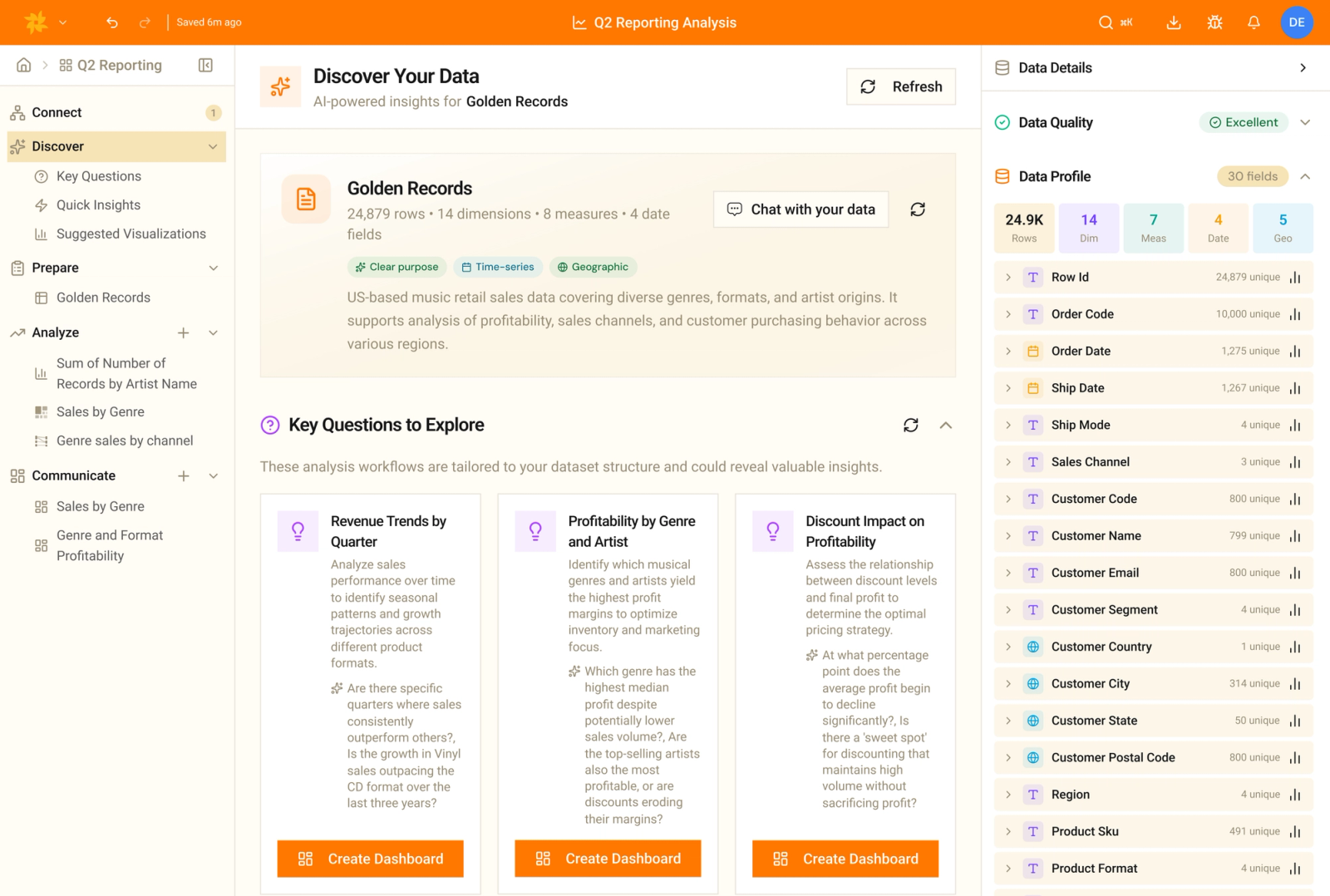
Real analysis on real schemas
On the Spider 2.0 benchmark, which uses enterprise-scale databases, the best model at publication solved about one task in five. In Golden the common analytical patterns are built in and run on your warehouse, so the model is choosing a step rather than inventing the SQL.

In Golden: one step from the question, and the grain is a dropdown.
In a chatbot: a Python script written fresh each time, on whatever export you uploaded.

In Golden: the rest of the tail is bucketed and labelled, so the total still ties out.
In a chatbot: the top ten look right, and whether the rest got summed depends on the run.

In Golden: the comparison holds, because the filter is part of the query.
In a chatbot: correct for the file you uploaded, out of date the day after.
The same question should get the same answer
LLM output varies between runs, even with settings meant to make it deterministic. That is fine for drafting an email and a problem for a revenue number. Golden keeps the model away from the arithmetic.
One path, not two
A change you make by clicking and a change the AI makes run through the same validated logic, so the chart on screen is always the chart the query produced. Every calculation the AI writes is one you can open and change.
Your data stays yours
Pasting company data into a personal chat account is how most data-leak stories start. Golden connects to your warehouse with the governance you already run, works from schema and statistics, and never trains models on customer data.
Analysis is a team sport
Chatbots: one person, one thread
You prompt, you get output, you move on. Nobody builds on what you did, the decision behind the number isn't stored anywhere, and the same question gets asked again next quarter. Turning a chat answer into something the team can open means building auth, permissions and refresh yourself.
Golden: Spaces, and one kind of seat
Shared work lives in Spaces, where the team can open it, ask a follow-up question and build on it in the same place. When a metric definition changes, it updates everywhere it is used.
AI-native means you choose how much the AI does
A chatbot gives you one setting: the AI does it. Golden gives you a slider, at every stage from connecting data to presenting it.

Golden: AI creates, you drive
Ask for a dashboard and you get a finished, styled one. Then change any chart by clicking a menu or typing "make this a line chart"; both run through the same logic. AI Creates means the AI does the first draft fast, and you take it from there.
Chatbots: all or nothing
General-purpose assistants are extraordinary engineering, built for every task at once. For data that means one model doing exploration, visualization and narrative in a single pass, and a fix to one chart is another prompt.
Simple pricing. Simple to get started.
A chat subscription covers one person asking questions. Shared dashboards built on top of it run on tokens, engineering time and the infrastructure someone has to maintain.
| Per user, per month | ChatGPT, Claude & co. | Golden Team | Golden Enterprise |
|---|---|---|---|
| Full authoring | Chat seat, plus API usage for anything built on it | $24 | $36 |
| Exploration | Within each plan's usage limits | Included | Included |
| Consumption | A shared dashboard means hosting, auth and refresh you build | Included | Included |
| Governance | Permissions and metric definitions are DIY | Included | Included |
| License planning | Seats plus token budgets that grow with every iteration | One seat does all four | One seat does all four |
Golden vs AI chatbots FAQs
We already pay for ChatGPT or Claude. Why add Golden?
Keep them. They are excellent for one-off questions, prototypes and demos where working today is the whole spec. Golden is for the analysis that has to hold up next quarter, be shared with the team, and return the same number to everyone who asks.
Can't we just connect a chatbot to our data warehouse?
You can, and some teams do. The usual next problem is two people getting two different answers to the same question, followed by token limits. Governance, permissions, version history and a shared component library all have to be built around it.
Why would Golden's AI be more accurate than a frontier model?
Golden uses frontier models too, a constellation of them, each tuned for a kind of data work. The difference is that the arithmetic runs as validated queries on your warehouse rather than inside the model, so the model chooses the analysis and the database computes the number.
What about vibe-coded dashboards?
Great for prototypes. Nobody owns the code, there is no version control by default, and security is DIY, so the cost shows up later in engineering time and lost trust.
What about our data and which AI models you use?
Golden uses all the major models so the right one gets used for the job, and we don't train on any customer data. We work from schema, statistics, and some clever techniques to keep the experience fast and safe.

Bring one question. We'll show you the day-and-night difference.
Pick a question you've asked a chatbot more than once. Ask Golden, then ask it again next week.
Product names and capabilities reflect publicly available information as of October 2026 and change often. Benchmark figure: Spider 2.0 (Lei et al., ICLR 2025), best reported agent at publication. Run-to-run variation in LLM output is documented by Thinking Machines Lab (2025) and in model providers' API documentation. Last reviewed October 2026.