
Golden vs Looker
Looker brought the governed semantic layer to BI, and LookML still keeps metrics honest. Golden is built for how people work now: ask a question, get a finished dashboard, ship it in two clicks.
Why do teams move from Looker to Golden?
Six reasons that change how fast you work, what's possible with your data, and how much it costs.
| Reason | Looker | Golden Analytics |
|---|---|---|
| 01Speed | A new metric is a LookML change: write it, review it, merge it, deploy it. The answer arrives after the pull request. | Two clicks to a finished dashboard. Fast to build, fast to render. |
| 02Depth | Anything outside the model means new LookML or a SQL Runner detour, so depth is gated by whoever owns the repository. | Running comparisons, top-N with an "other" bucket and cohort analysis are built in. No expert required to get an answer. |
| 03Trust | The model is genuinely trustworthy. The cost is that every change to it runs through a developer workflow. | Every action, typed or clicked, runs through the same validated logic. We never train models on customer data. |
| 04Collaborate | Business users explore what the model already exposes. Everything past that is a ticket to the data team. | Spaces put the work where the team already is. Every seat can open, ask and explore what's shared, with no license mapping in between. |
| 05AI-native | AI added on top. Conversational Analytics and Gemini sit beside the classic Explore workflow. | AI-native. The AI and the human are peers, and both flow through the same logic. |
| 06Simple | Sold through Google Cloud on annual contracts with no published rates. Independent reports put platform plus user costs in the tens of thousands a year. | $24 a seat for Team, $36 for Enterprise, billed annually. Authoring, sharing, exploration, consumption and AI are all included. |
Insights worth sharing in just two clicks.
Golden wins on the speed of everything. Building a dashboard takes two clicks instead of forty plus. Analysis that used to be an afternoon happens in the flow of a question.
How Golden gets there →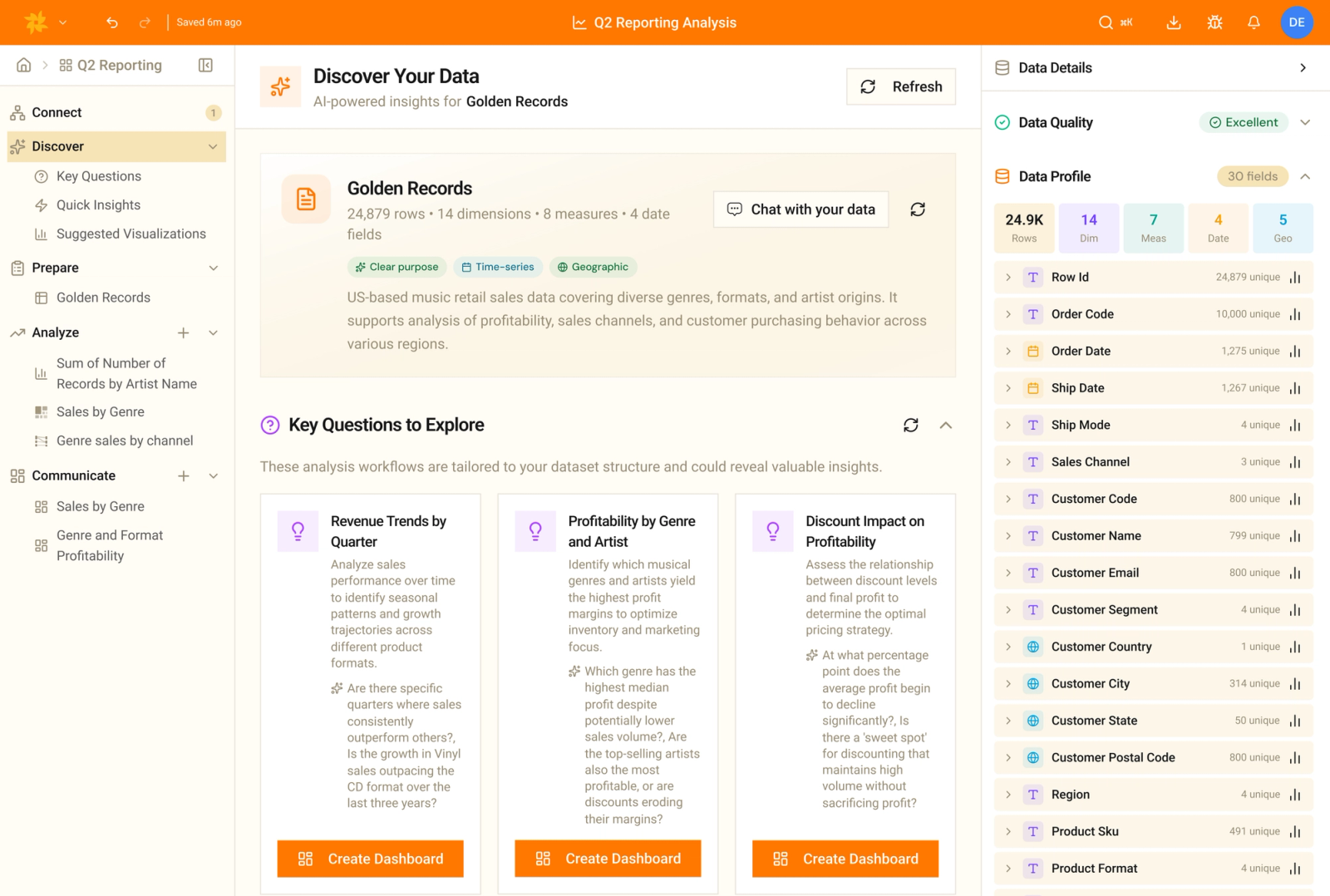
Complex analysis without the time and workaround
Want a running comparison, or a clean top-N with an "other" bucket? In Looker that often means new LookML, a review, and a deploy before anyone sees the number. In Golden the pattern is a step, and the depth underneath it is still there when you need it.

In Golden: one step from the question, and the grain is a dropdown.
In Looker: a derived table and a LookML change, reviewed and merged before it renders.

In Golden: the rest of the tail is bucketed and labelled, so the total still ties out.
In Looker: a custom dimension plus a filtered measure, and the long tail quietly disappears.

In Golden: the comparison holds, because the filter is part of the query.
In Looker: period-over-period logic modelled ahead of time, or not available at all.
You can check every number it gives you
Analysts stake their credibility on the numbers they hand over. Golden is built so the answer on screen is one you can trace all the way back.
One path, not two
A change you make by clicking and a change the AI makes run through the same validated logic, so the chart on screen is always the chart the query produced. Nothing is generated outside the model you already trust.
Your data stays yours
We never train models on customer data. Golden works from schema and statistics, uses all the major models so the right one gets used for the job, and connects to the warehouse and governance you already run.
Sharing work shouldn't need a license map
Looker: explore inside the model, or file a ticket
Looker's governance is real, and the semantic layer is why people trust the numbers. The trade is that anything the model doesn't already expose goes back to the team who writes LookML, so the queue is where most questions wait.
Golden: Spaces, and one kind of seat
Shared work lives in Spaces, where the team can open it, ask a follow-up question and build on it in the same place. One seat covers authoring, exploration and consumption, so nobody is waiting on a license change to answer their own question.
What does "AI-native" actually mean?
There's a simple test. Ask what happens if you remove the AI. Take Conversational Analytics and Gemini away and Looker is still Looker. Remove Golden's AI and the product no longer makes sense.

Golden: AI in the foundation
Whether you change a chart by clicking a menu or by typing "make this a line chart," both actions flow through the same validated logic. Ask for a dashboard and you get a finished, styled dashboard that's ready to share.
Looker: AI on top
Gemini in Looker is real engineering. But the interaction model (model in LookML, then explore what the model exposes) was designed long before AI showed up. The human is the only author. The AI suggests, you go edit the model.
Simple pricing. Simple to get started.
Golden makes it easy, from our simple pricing model, no hidden fees or token add-ons, and no hassle managing users across different license types.
| Per user, per month | Looker | Golden Team | Golden Enterprise |
|---|---|---|---|
| Full authoring | Not published | $24 | $36 |
| Exploration | Not published | Included | Included |
| Consumption | Not published; viewer seats commonly reported near $400 a year | Included | Included |
| AI agent | Gemini features sold through Google Cloud | Included | Included |
| License planning | Platform fee plus tiered user licenses | One seat does all four | One seat does all four |
Golden vs Looker FAQs
What does "AI-native" really mean here?
It's an architecture, not a feature. A change you make by clicking and a change the AI makes both run through the same validated logic. Ask for a dashboard and you get a finished one, not a wireframe.
We have years of LookML. Is switching painful?
You don't rebuild everything on day one. Golden connects to the warehouse and models you already have, so you can run it beside Looker, move the reports that matter most, and let the long tail age out.
Isn't Looker's semantic layer the whole point?
Governed metrics matter, and Looker was right about that. The gap now is everywhere around the model: how fast a new question gets answered, who is allowed to ask it, and what the contract costs.
How is Golden easier to buy?
Looker is a sales-led annual contract through Google Cloud with no published rates. Golden is $24 a seat on Team and $36 on Enterprise, billed annually, with authoring, sharing, exploration, consumption and AI included.
What about our data and which AI models you use?
Golden uses all the major models so the right one gets used for the job, and we don't train on any customer data. We work from schema, statistics, and some clever techniques to keep the experience fast and safe.

Bring one question. We'll show you the day-and-night difference.
Pick a report your team keeps rebuilding in Looker. Ask Golden the same question in plain language.
Pricing, product names, and feature details reflect publicly reported information as of mid-2026 and are subject to change. Looker is sold through Google Cloud on a sales-led basis and publishes no list rates; any figures shown are third-party reports rather than Google rates. Last reviewed September 2026.