Every BI Vendor Has AI. That Doesn't Make Them AI-Native.
Adding AI to traditional BI isn't the same as building analytics for the AI era. Explore the principles that define a genuinely AI-native platform.
AI is transforming analytics, but not every AI-powered analytics platform is created equal.
Today, nearly every BI vendor offers AI capabilities. Chatbots, copilots, natural language queries, and agents are becoming standard features.
But adding AI to a traditional BI platform isn't the same as building analytics for the AI era.
So how can organizations tell the difference?
A new analyst report from John Santaferraro, The Seven Principles of Agentic Analytics, provides a framework for evaluating what makes an analytics platform genuinely AI-native.
Moving beyond AI feature checklists
The real opportunity with AI isn't simply to make existing BI workflows faster. It's to fundamentally rethink how people work with data.
Traditional BI tools require users to understand the mechanics of analytics: building calculations, configuring visualizations, creating dashboards, and navigating complex interfaces.
AI has the potential to remove much of that complexity, making sophisticated analytics accessible to far more people.
But delivering on that promise requires more than a chatbot.
It requires a different approach to architecture, user experience, trust, and automation.
What defines an AI-native analytics platform?
The report establishes seven principles for evaluating agentic analytics platforms. Several important themes emerge:
- AI at the core, not bolted on. AI should be integrated throughout the analytics experience, not added as a conversational layer on top of existing workflows.
- Humans remain in control. Users should decide when to work directly with data, when to collaborate with AI, and when to delegate work to agents.
- Multiple ways to work. Chat, point-and-click exploration, and autonomous agents should work together seamlessly.
- Trust and transparency. AI-generated analyses must be grounded in reliable data, with calculations and results that users can inspect and verifyAI is transforming analytics, but not every AI-powered analytics platform is created equal.
Today, nearly every BI vendor offers AI capabilities. Chatbots, copilots, natural language queries, and agents are becoming standard features.
But adding AI to a traditional BI platform isn't the same as building analytics for the AI era.
So how can organizations tell the difference?
A new analyst report from John Santaferraro, The Seven Principles of Agentic Analytics, provides a framework for evaluating what makes an analytics platform genuinely AI-native.
Moving beyond AI feature checklists
The real opportunity with AI isn't simply to make existing BI workflows faster. It's to fundamentally rethink how people work with data.
Traditional BI tools require users to understand the mechanics of analytics: building calculations, configuring visualizations, creating dashboards, and navigating complex interfaces.
AI has the potential to remove much of that complexity, making sophisticated analytics accessible to far more people.
But delivering on that promise requires more than a chatbot.
It requires a different approach to architecture, user experience, trust, and automation.
What defines an AI-native analytics platform?
The report establishes seven principles for evaluating agentic analytics platforms. Several important themes emerge:
- AI at the core, not bolted on. AI should be integrated throughout the analytics experience, not added as a conversational layer on top of existing workflows.
- Humans remain in control. Users should decide when to work directly with data, when to collaborate with AI, and when to delegate work to agents.
- Multiple ways to work. Chat, point-and-click exploration, and autonomous agents should work together seamlessly.
- Trust and transparency. AI-generated analyses must be grounded in reliable data, with calculations and results that users can inspect and verify.
- Continuous learning. Analytics platforms should improve over time, learning from user behavior, organizational context, and previous analyses.
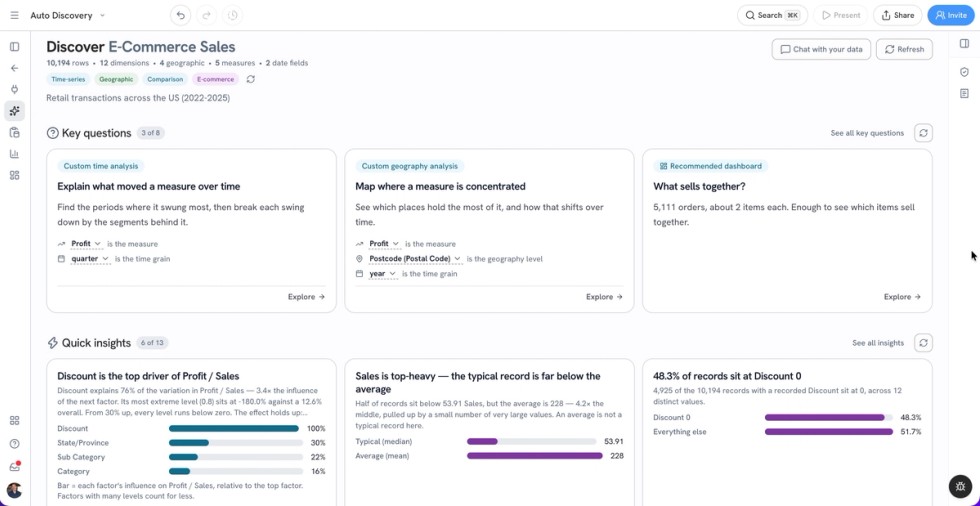
The distinction also becomes clear in how the experience begins. Traditional analytics tools often start with a blank canvas and require users to determine what to build. An AI-native platform can begin with discovery—suggesting relevant questions, identifying potential insights, and presenting useful ways to explore the data from the moment it is connected.
Trust must be equally foundational. That means more than grounding AI in a semantic layer. Users should be able to inspect calculations and queries, understand data-quality issues, apply organizational context, and collaborate with others to validate the result.
These principles move the conversation beyond which vendor has the most AI features to a more important question: Does AI fundamentally change what people can accomplish with data?
How Golden measures up
Golden Analytics sponsored the research, which also included an evaluation of our platform against the seven principles.
Golden received Exceptional ratings for people-centered design and AI-native architecture, along with Excellent ratings for agent accessibility, end-to-end analytics, and multimodal interaction.
The report also highlighted opportunities for improvement in governance and continuous learning, areas we're actively investing in.
John Santaferraro concluded that Golden deserves consideration among the top three platforms for organizations evaluating agentic analytics.
A practical guide to choosing AI-native analytics
To help organizations apply these principles, we've published a Guide to Choosing an AI-Native Analytics Solution.
The guide translates the research into practical evaluation criteria, questions to ask vendors, and warning signs to watch for.
One particularly useful question:
If you removed the AI, would the product fundamentally change?
It's a simple way to start separating AI-native platforms from traditional BI with AI added on.
AI represents an opportunity to make analytics dramatically easier, faster, and more accessible. But realizing that potential requires more than adding AI features.
It requires rethinking analytics from the ground up.
Read the full analyst report and explore our AI-native analytics buyer's guide..
- Continuous learning. Analytics platforms should improve over time, learning from user behavior, organizational context, and previous analyses.
These principles move the conversation beyond which vendor has the most AI features to a more important question: Does AI fundamentally change what people can accomplish with data?
How Golden measures up
Golden Analytics sponsored the research, which also included an evaluation of our platform against the seven principles.
Golden received Exceptional ratings for people-centered design and AI-native architecture, along with Excellent ratings for agent accessibility, end-to-end analytics, and multimodal interaction.
The report also highlighted opportunities for improvement in governance and continuous learning, areas we're actively investing in.
John Santaferraro concluded that Golden deserves consideration among the top three platforms for organizations evaluating agentic analytics.
A practical guide to choosing AI-native analytics
To help organizations apply these principles, we've published a Guide to Choosing an AI-Native Analytics Solution.
The guide translates the research into practical evaluation criteria, questions to ask vendors, and warning signs to watch for.
One particularly useful question:
If you removed the AI, would the product fundamentally change?
It's a simple way to start separating AI-native platforms from traditional BI with AI added on.
AI represents an opportunity to make analytics dramatically easier, faster, and more accessible. But realizing that potential requires more than adding AI features.
It requires rethinking analytics from the ground up.
Read the full analyst report and explore our AI-native analytics buyer's guide.