How BI Tools Charge for AI in 2026: Seats, Credits, Tokens and Compute
Seats, premium tiers, credits, tokens or compute: here's how Tableau, Power BI, Looker, Domo, Databricks, ThoughtSpot and Qlik charge for AI in 2026, and what to ask before you buy.
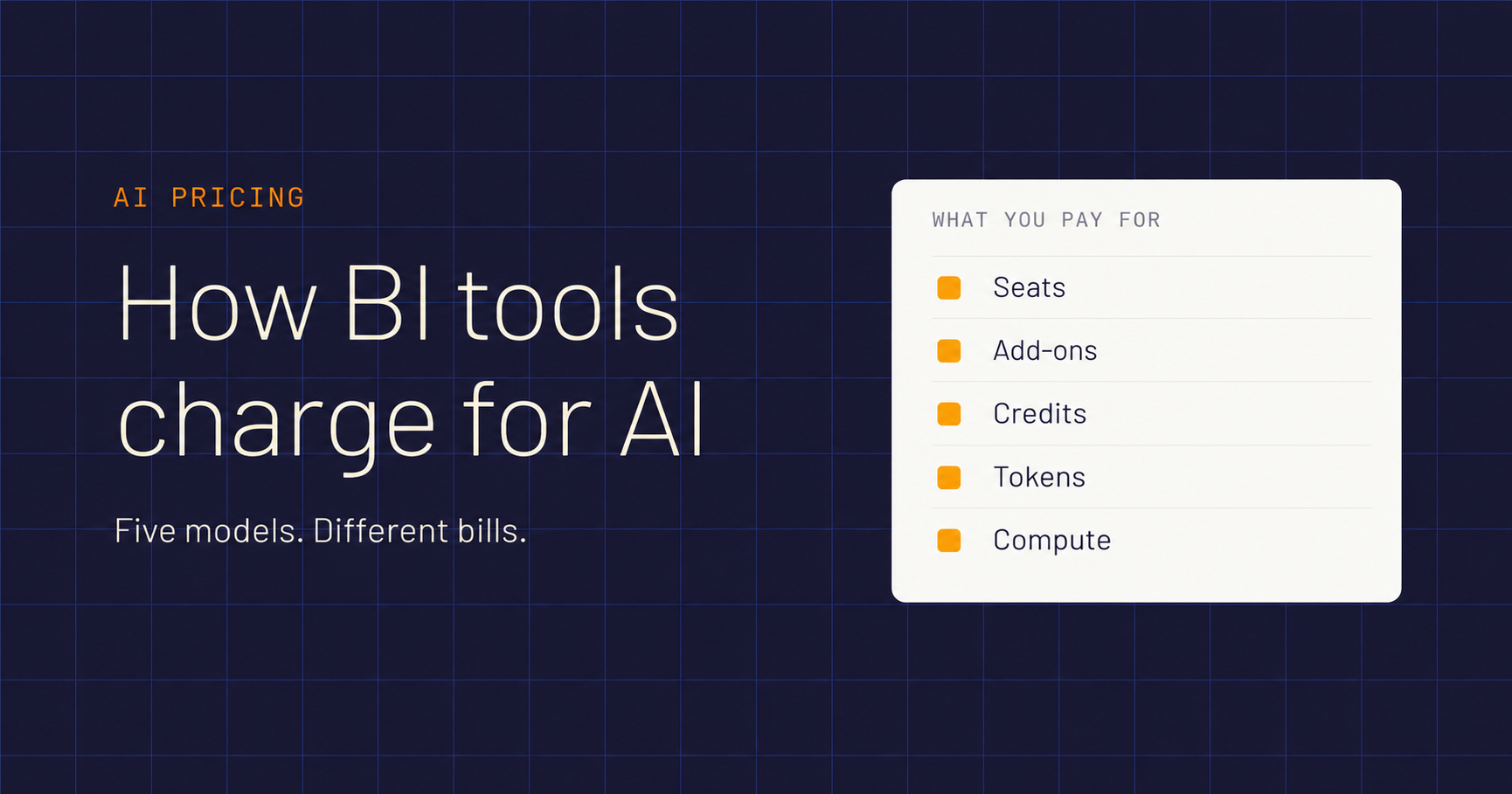
Every BI vendor now has an AI assistant. What's much harder to figure out is what that assistant costs.
Some vendors bundle AI into a seat. Some sell it as a premium tier. Others meter it in credits, tokens, capacity units or compute. The result is that two tools with similar demos can produce very different bills once your team actually starts asking questions.
We looked at the official pricing pages and documentation for the major BI and analytics vendors to see how each one charges for AI. Every claim below links to a vendor source, checked on November 7, 2026. Where a vendor doesn't publish a price, we say so instead of guessing. Pricing changes often, so confirm the details with each vendor before you buy.
The five ways BI vendors charge for AI
1. AI included in a per-user seat
You pay a fixed price per person, and AI comes with it. This is the easiest model to forecast: your bill changes when headcount changes, not when curiosity does. The catch is that some vendors include AI only in their top tier, or include a capped number of AI questions per seat.
2. Premium tier or add-on
The base product is priced per user, but AI features sit in a higher edition or a separate add-on. The headline price you see on the pricing page may not include the AI you saw in the demo.
3. Credits
You buy a pool of credits up front, and actions such as storing data, running workflows or calling AI draw that pool down. Credits make it possible to offer unlimited users, but they turn every action into something you have to estimate and watch.
4. Tokens
You pay for the text the AI model reads and writes, measured in tokens. This is how model APIs are priced, and some BI vendors now pass it through, often with a monthly allowance and overage rates. The problem is that most business users have no idea how many tokens a question will use.
5. Capacity or compute consumption
AI runs on a shared compute pool, such as capacity units or DBUs, alongside everything else in the platform. AI usage competes with dashboards and data refreshes for the same capacity, and the queries the AI generates are often billed separately from the AI itself.
Vendor-by-vendor comparison
Here's how the major vendors price AI today, based on their own published pages (checked November 7, 2026).
- Tableau (Cloud and Server): Per-user seats with annual contracts. Standard starts at $15 and Enterprise at $35 per user per month, billed annually. Tableau Agent in Tableau Cloud and Pulse is part of the Tableau Cloud+ edition and Tableau+ Bundle, whose prices are not published. Tableau says AI in Tableau stopped consuming Einstein Request credits in October 2025, though the optional AI audit trail still uses Data 360 credits. (Tableau pricing, AI in Tableau usage)
- Tableau Next: Role-based pricing starting at $40 per user per month, billed annually. Salesforce says AI usage, queries and transforms are now unmetered, but notes that Data Services or Flex Credits may still apply to other services. (Tableau Next pricing)
- Microsoft Power BI: Pro is $14 and Premium Per User is $24 per user per month, paid yearly. Copilot requires a paid Fabric capacity (F2 or higher) or Power BI Premium (P1 or higher); a Pro or PPU license alone isn't enough. Copilot usage is billed by token consumption, drawn from capacity units, and the queries and refreshes it triggers are billed separately. (Power BI pricing, Copilot for Power BI)
- Looker (Google Cloud): Platform and user licenses are quoted by sales. Conversational Analytics is measured in data tokens. Each internal user adds 1 million input and 20,000 output tokens a month to a shared pool. Starting February 1, 2027, usage above the pool is billed at $3 per million input tokens and $20 per million output tokens. Until then, usage is promotional and uncapped within fair use. (Looker pricing)
- Domo: Credit-based pricing with unlimited users. Credits are consumed when you store data, update tables, run workflows and use ML inference. The credit price is not published. (Domo pricing)
- Databricks AI/BI Genie: Consumption-based. Genie LLM usage is billed in DBUs, at $0.070 per DBU, and each user gets 150 free DBUs a month (about $10.50 in US East). Genie One and Genie Agents are free for users through January 31, 2027. The compute that runs Genie's queries, such as SQL Serverless, is billed separately and isn't covered by the free allowance. (Genie pricing, Genie cost docs)
- ThoughtSpot: Per-user and credit-based plans. ThoughtSpot says it doesn't meter or charge for LLM tokens. Essentials is $25 per user per month without the Spotter AI agent. Pro is $50 per user per month with Spotter capped at 25 queries per user per month. A credit-based plan starts at $0.10 per credit. (ThoughtSpot pricing)
- Qlik Cloud Analytics: Capacity-based, priced on data volume. Starter is $300 a month for 10 users; Standard starts at $825 a month and Premium at $2,750 a month. Qlik Answers runs on a monthly question quota that depends on your subscription, with extra capacity sold separately. Qlik doesn't publish the price of that extra capacity, and on some subscriptions users can't ask more questions until the quota resets. (Qlik pricing, Qlik Answers FAQ)
- General AI chat tools: ChatGPT Business is $20 per user per month billed annually ($25 monthly), with credits for usage beyond included limits. Claude Enterprise is $20 per seat per month plus usage billed at API rates. Both APIs are priced per token. These tools are useful, but they aren't connected to your governed metrics by default. (ChatGPT Business, Claude pricing)
The hidden costs to watch for
The price per seat or per credit is only part of the story. These are the costs that tend to show up later.
The AI and the query are billed separately
On compute-based platforms, the AI writes a query, and running that query is a separate charge. Databricks says this explicitly: Genie's free allowance covers LLM usage only, not the SQL compute behind it. Microsoft bills Copilot-triggered queries and refreshes through standard Fabric pathways.
The AI tier isn't the tier on the pricing page
Starting prices often exclude the AI features. Check which edition the demo was running on and whether that edition's price is public.
Caps you'll only notice in month two
A fixed number of AI queries per seat, or a monthly question quota, can look generous in a pilot and run out once a team adopts the tool. Ask what happens when you hit the limit: overage, throttling or a hard stop.
Promotional periods end
Several vendors are offering free or discounted AI usage for now. Looker's token billing begins February 1, 2027, and Databricks' Genie One and Agents promotion runs through January 31, 2027. Budget for the price after the promotion, not during it.
Shared capacity
When AI draws from the same capacity as your dashboards and refreshes, heavy AI use can slow everything else down or push you into a bigger capacity.
Questions to ask every vendor
- What does AI cost per user at two or three times our expected usage?
- Is the compute that runs AI-generated queries billed separately?
- Which edition includes the AI features we saw in the demo, and what does it cost?
- Is there a cap on AI questions, and what happens when we reach it?
- Is any of today's AI pricing promotional, and when does it end?
- Can we see real usage and cost before the bill arrives?
For a broader evaluation checklist, see What to Ask Vendors Who Claim to Be AI-Native.
How Golden prices AI
Golden is priced per user, and AI is included. Paid plans are $30 and $45 per user per month. There are no token fees, no credits to buy and no consumption calculator to fill in.
We chose this on purpose. The point of analytics is curiosity, and we don't want anyone stopping to ask whether a follow-up question is worth the cost. We explain the reasoning in Why Golden Analytics Doesn't Charge for Tokens.
Because we pay for the AI, we have every reason to make it efficient. Golden routes each task to the right model behind the scenes, so you don't have to think about model choice or token budgets. Golden generates insights and dashboards in minutes, with about 60 visualizations to choose from, and we don't train models on your data.
See the details on our pricing page. If you're comparing options, our guides to Tableau alternatives and Databricks Genie go deeper.
FAQ
Do BI tools charge extra for AI?
Many do, in different ways. Some include AI in a seat, some put it in a higher edition, and others meter it in credits, tokens or compute. Check whether the AI you saw in a demo is included in the plan you're pricing.
What is token-based pricing in analytics?
You pay for the text an AI model reads and writes, measured in tokens. Looker, for example, measures Conversational Analytics in input and output data tokens, with a monthly allowance and overage rates starting in 2027.
Does Power BI Copilot require Fabric capacity?
Yes. According to Microsoft, Copilot requires a paid Fabric capacity (F2 or higher) or Power BI Premium (P1 or higher). A Pro or Premium Per User license alone isn't sufficient.
Is per-user or consumption pricing cheaper for AI analytics?
It depends on usage. Consumption pricing can be cheaper for light use, but costs rise with every question. Per-user pricing with AI included is easier to forecast and doesn't discourage people from exploring.
How does Golden charge for AI?
Golden's paid plans are $30 and $45 per user per month, with AI included and no token fees.
Try it without a token budget
The best way to compare AI pricing is to see how much your team actually asks once nobody is counting. Sign up for Golden and ask as many questions as you want.